📑 On this page
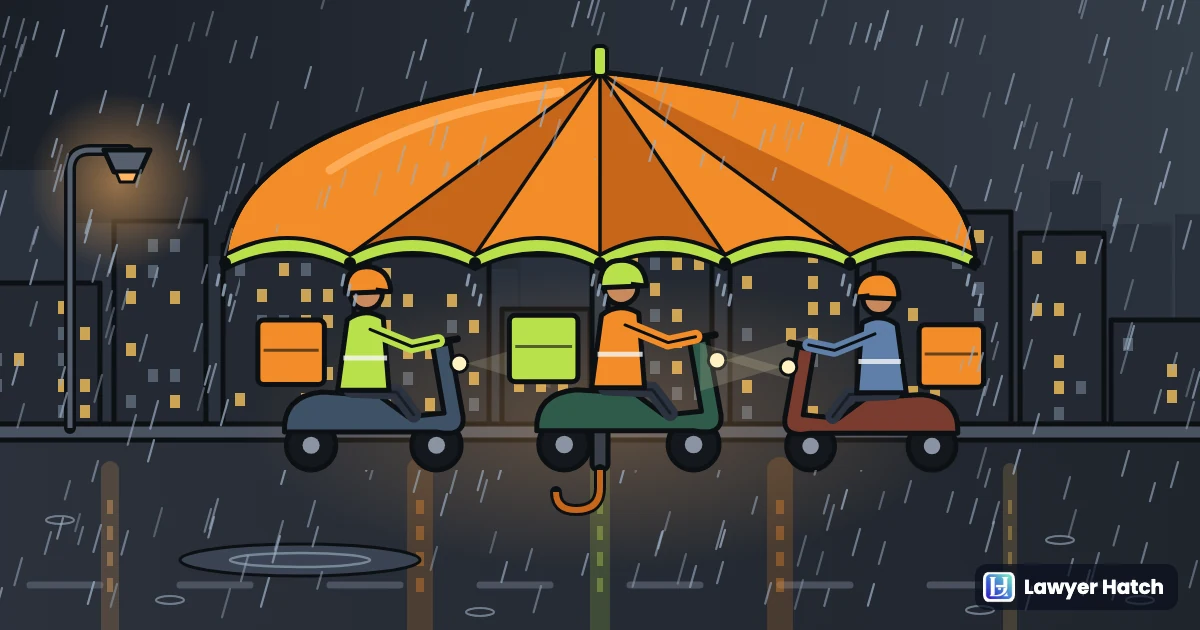
It is raining in Gurugram at 10 pm. A rider in a lime jacket waits outside a restaurant, phone in a plastic pouch, watching the app tell him he has eleven minutes. If he skids on the flyover, who pays the hospital bill? Not the restaurant. Not the customer. And the app will tell you, politely, that he is not its employee.
That gap is what India's newest welfare bodies are meant to close. On Friday, 30 October 2026, the Union Labour Ministry notified two National Social Security Boards: a 40-member board for unorganised workers and a 22-member board for gig and platform workers. Within a day The Hindu's editorial board called the design too centralised. So the real story is not just that the boards exist. It is who got a chair, and what the chairs can actually do.
- What happened: on 30 October 2026 the Labour Ministry notified two National Social Security Boards under the Code on Social Security, 2020, one for unorganised workers (40 members) and one for gig and platform workers (22 members).
- Who leads them: both are chaired by the Union Labour Minister, Mansukh Mandaviya, with the Labour Secretary as vice-chairperson.
- What they do: recommend schemes, advise the Centre, monitor central welfare schemes and review spending from the fund. They advise; the Centre decides.
- Where the money comes from: a social security fund fed by the Centre, states, CSR money and aggregators, who pay 1-2% of annual turnover, capped at 5% of what they pay their workers.
- The fight: The Hindu says Opposition-aligned central trade unions and Opposition-ruled states are missing, even though labour is a Concurrent List subject. The government calls the boards a historic shift.
A worker with no boss on paper
Most of India's labour law was built around one relationship: an employer who hires, and an employee who is hired. Provident fund, insurance and maternity benefit all hang on that hook. A delivery rider, a cab driver on an app or a beautician booked through a home-services platform does not fit it neatly. They log in when they like, can work for two apps on the same day, and are paid per task.
The Code on Social Security, 2020 is one of India's four labour codes. It merged nine social security laws, and all four codes were brought into force together in November 2025. Its quiet revolution is a set of definitions. For the first time, Indian law named these workers:
| Term | What it means in plain words | Example |
|---|---|---|
| Gig worker | Someone who earns from a work arrangement outside the traditional employer-employee relationship | A freelance photographer booked for weddings |
| Platform work | Work where people or businesses use an online platform to reach others and solve a problem or provide a service, for payment | Ordering a plumber through an app |
| Platform worker | A person who does platform work | The plumber who took that booking |
| Aggregator | A digital intermediary or marketplace that connects the buyer of a service with its provider | The app company in the middle |
Notice the logic. Every platform worker is a kind of gig worker, but not every gig worker uses a platform. And the definition does not pretend the app is an employer. It builds a separate track: register the worker, create a fund, and let schemes reach him without first winning the argument about who employs him.
Two tables, two guest lists
The Code had promised a National Social Security Board from the start. Last week the Centre finally filled the seats, splitting it into two bodies. Here is who sits where, according to the notification as reported by The Indian Express and The Hindu.
| Board for unorganised workers | Board for gig and platform workers | |
|---|---|---|
| Size | 40 members | 22 members |
| Chair / vice-chair | Union Labour Minister / Labour Secretary | Union Labour Minister / Labour Secretary |
| Workers' side | 7 representatives; the Bharatiya Mazdoor Sangh (BMS) holds 3 | 5 representatives, among them BMS, the Indian Federation of App-Based Transport Workers (IFAT) and the National Front of Indian Trade Unions (NFITU) |
| Employers' side | 7 representatives; Laghu Udyog Bharati, which works for small industry, holds 3 | 5 aggregator representatives, among them Eternal (Zomato's parent), Swiggy, Zepto and Urban Company |
| Everyone else | Officials from government departments and Members of Parliament | Central and state government representatives and experts (the PIB release says both boards include Central and State Government representatives) |
Two details matter for the argument coming later. First, every member is nominated by the Union government. Second, the Indian Express points out that BMS and Laghu Udyog Bharati are both linked to the Rashtriya Swayamsevak Sangh, and together hold six of the fourteen seats set aside for workers and employers on the bigger board.
Recommend, advise, monitor, review: the verbs that matter
A board is only as strong as the verbs in its job description. The Press Information Bureau release lists six functions. Read the verbs, not the adjectives.
- Recommend to the Centre suitable schemes for different groups of unorganised, gig and platform workers.
- Advise the Centre on matters arising out of the Code that are referred to it.
- Monitor welfare schemes for these workers that the Centre runs.
- Review the record-keeping done at the state level.
- Review spending from the fund and its accounts.
- Do any other work the Centre assigns to it.
So what can the boards not do? Nothing in that list lets them create a scheme on their own, fix a rider's pay per order, or settle a dispute between a worker and an app. The Code says it is the Centre that frames schemes, on life and disability cover, accident insurance, health and maternity benefits, old-age protection and creches. The boards must meet at least three times a year. Think of them as a standing committee with a seat for each interest, not a regulator with teeth.
That is not automatically a weakness. Advisory bodies can matter a great deal if the people in the room carry weight and the government listens. It does mean the fight over membership is really a fight over whose advice reaches the minister.
Follow the money
The boards advise on how to spend a social security fund. Under the Code, it can draw on the Centre, state governments, corporate social responsibility (CSR) money, fines collected when offences are compounded, and aggregators.
The aggregator share is the headline. Platforms such as Zomato, Swiggy, Amazon and Flipkart are to contribute 1-2% of their annual turnover, with a ceiling: the total cannot exceed 5% of the amount they pay or owe to gig and platform workers. The cap protects platforms with thin margins; the floor makes sure the fund is not left to charity.
Then there is the problem of finding the workers. The e-Shram portal, launched in 2021 as a national database of unorganised workers, had 31.89 crore registrations by its fifth anniversary in August 2026, but only about 11.5 lakh platform workers. NITI Aayog expects the sector to employ 2.35 crore people by 2029-30. The Code plans registration through an Aadhaar-linked Universal Account Number, so a rider who moves from Patna to Pune does not lose his benefits at the state border.
The states did not wait for the Centre. Rajasthan passed the Platform Based Gig Workers (Registration and Welfare) Act in 2023, and Karnataka passed its Platform Based Gig Workers (Social Security and Welfare) Act in 2025. Both charge platforms a welfare fee linked to each transaction or payout, not to annual turnover. That is one reason the editorial complaint about missing states is more than a ceremonial point.
The fight over the chairs
The Hindu's editorial of 31 October, headlined "Suboptimal outcomes", welcomed the boards as a delayed but positive step and then made its case against the design. The government's case is in the PIB release. Here are both, at their strongest.
| The Hindu's worry | The case for the design |
|---|---|
| Too centralised. The Union minister chairs both boards and the Centre nominates every member. | A minister in the chair means recommendations land directly with the person who can act on them, instead of being lost between ministries. |
| Missing voices. No significant seats for central trade unions from the Opposition side. | Workers and employers each get their own block of seats, and the gig board seats the platforms themselves and app-worker federations, not only legacy unions. |
| Missing states. Labour is in the Concurrent List, so the Centre and states must work together, yet Opposition-ruled states are not meaningfully represented. | The Code is a national law with a national fund and a portable, Aadhaar-linked ID; one national board avoids 28 different rulebooks for a worker who crosses states. |
| The bigger gap remains. Unorganised and gig workers, over 92% of the workforce, are far from social security in the ILO's sense. | The PIB release calls the boards a historic shift that brings gig and platform workers into India's formal welfare system for the first time. |
The editorial also reaches back. Almost two decades ago, the National Commission for Enterprises in the Unorganised Sector, headed by economist Arjun Sengupta, recommended a set of social security measures for informal workers, and The Hindu says those issues remain unaddressed. It also cites a report by Justice V. Gopala Gowda, prepared for the Keralam government in March 2026, which flagged what it called anti-federal and anti-worker features in the Code.
What is settled: the boards exist, their membership is fixed by Union nomination, and their powers are advisory. What is genuinely open: whether a board without Opposition unions and states will produce schemes that work on the ground, which depends on implementation that states largely carry out. Neither side can prove that yet.
19, 64.3, 68.4: whose number is it?
You will see three numbers in this debate. Each comes from a different speaker at a different time, and CLAT likes questions that check whether you kept track.
| Number | What it claims | Who says so |
|---|---|---|
| 19% | Share of India's population covered by at least one social protection benefit in 2015 (about 25 crore people) | Union government, citing ILO data |
| 64.3% | Coverage in 2025, about 94 crore people | Union government, citing ILO data; The Hindu repeats it as the government's claim |
| 68.4% | Coverage in 2026, over 100 crore people | Labour Minister Mandaviya, July 2026; the ILO Director-General said ILO running estimates show India's system reaches 1 billion people |
The catch is in how the ILO counts. A scheme counts only if it is backed by law and pays cash benefits, so non-cash food and health schemes are left out. The 2025 figure also rested on partial data covering central schemes and women-centric schemes in eight states. Coverage by at least one scheme is also not the same as the full protection the ILO's own definition describes: health care plus income security in old age, unemployment, sickness, injury, maternity or the loss of a breadwinner.
The Constitution and the static GK
The Constitution treats work as a shared job. In the Seventh Schedule's Concurrent List, entry 22 covers trade unions and industrial and labour disputes, entry 23 covers social security and social insurance, employment and unemployment, and entry 24 covers welfare of labour, including provident funds, old-age pensions and maternity benefits. Parliament and state legislatures can both make laws on these, and if they clash, central law generally prevails. That is how a national Code and the Rajasthan and Karnataka Acts can exist side by side.
The Directive Principles add the moral brief. Article 41 asks the State, within its economic capacity, to provide public assistance in cases of unemployment, old age, sickness and disablement. Article 42 asks for just and humane conditions of work and maternity relief. Article 43 asks the State to try to secure a living wage and a decent standard of life for all workers, agricultural, industrial or otherwise. They cannot be enforced in court, but they explain why Parliament keeps legislating here.
| Fact | Detail |
|---|---|
| The law | Code on Social Security, 2020, one of four labour codes, in force from November 2025 |
| The boards | National Social Security Boards for unorganised workers (40) and gig and platform workers (22), notified 30 October 2026 |
| Chair | Union Minister for Labour and Employment, Mansukh Mandaviya |
| Constitutional home | Concurrent List (List III), entries 22, 23, 24 |
| Directive Principles | Articles 41 (public assistance), 42 (humane work, maternity relief), 43 (living wage) |
| ILO | International Labour Organization, a UN agency headquartered in Geneva, founded in 1919; India is a founding member |
| e-Shram | National database of unorganised workers, launched 2021; 31.89 crore registrations by August 2026 |
| NCEUS | National Commission for Enterprises in the Unorganised Sector, headed by Arjun Sengupta |
| State laws | Rajasthan (2023) and Karnataka (2025) gig worker Acts |
Six questions from a delivery shift
Read the short passage, then try the questions. Some use the passage, some use linked GK, and two give you a rule and ask you to apply it.
Which statement best describes the role of the National Social Security Boards as presented in the passage?
▸ Show solution
Social security and social insurance appear as an entry in which part of the Constitution?
▸ Show solution
Rule: a 'gig worker' is a person who earns from a work arrangement outside the traditional employer-employee relationship. A 'platform worker' is a gig worker who reaches customers through an online platform. Shabana is paid per blouse by one boutique, which sends her orders by phone call; she has no salary or fixed hours. Joseph is a salaried warehouse supervisor on a quick-commerce company's payroll, with a provident fund account. Which is correct?
▸ Show solution
The editorial argues that because the Centre nominated every member and left out Opposition-aligned unions and states, the boards will produce suboptimal outcomes. Which of these, if true, most weakens that argument?
▸ Show solution
The government says social security coverage rose from 19% in 2015 to 64.3% in 2025, a figure that counts only legally backed schemes paying cash benefits. Which conclusion can be drawn?
▸ Show solution
Suppose an aggregator has an annual turnover of Rs 10,000 crore and pays Rs 3,000 crore to its gig workers in the year. The Centre fixes the contribution at 2% of turnover, subject to a cap of 5% of the amount paid to gig and platform workers. How much must it contribute?
▸ Show solution
Read next
Sources
- PIB: Government notifies National Social Security Board for Unorganised Workers and Gig & Platform Workers under the Labour Codes (30 Oct 2026)
- The Indian Express: Unorganised, gig workers' welfare boards, powers, duties and what changes for workers
- The Hindu (editorial): Suboptimal outcomes
- The Pioneer: Social protection covers 100 crore Indians, says Mandaviya
- IANS: India's social security coverage leaps from 19 pc to 64.3 pc
- IANS: e-Shram portal marks five years with 31.89 crore registrations
- MediaNama: What the Code on Social Security says about gig and platform workers
- Constitution of India: Articles 41-43 and Seventh Schedule, List III, entries 22-24
Frequently asked questions
What are the National Social Security Boards notified in October 2026?
Who chairs the social security board for gig workers?
Which companies are on the gig and platform workers board?
How much do aggregators contribute to the gig worker social security fund?
Is labour a Union, State or Concurrent subject?
Why did The Hindu criticise the boards?
Keep reading