📑 On this page
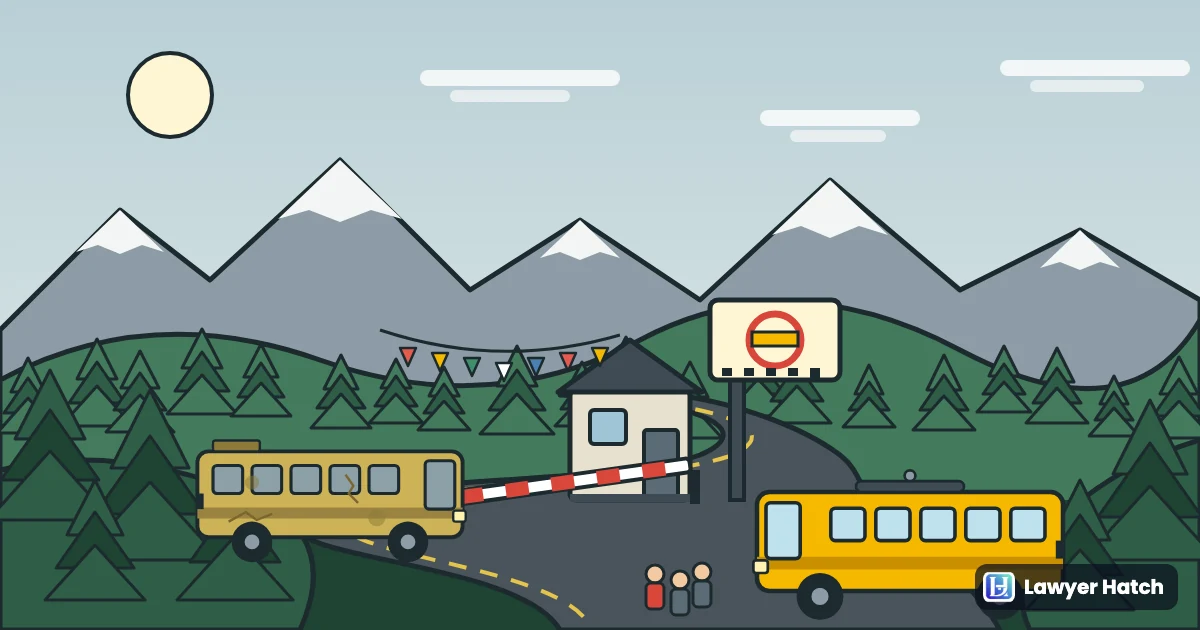
A school bus is bought, painted dark yellow, fitted with a speed governor and put on the hill roads. Fifteen years on, the law says it can no longer carry a single student in Himachal Pradesh. It is not scrapped. It can still do other work. It just cannot do the school run.
On 31 October 2026 the Himachal Pradesh High Court upheld that rule and dismissed 21 writ petitions from schools, educational societies and nursing institutes. The rule exists because of one afternoon in April 2018, when a bus went into a gorge.
For a CLAT student the case is a tidy puzzle in two layers. First: who is allowed to make this rule, the State or the Centre? Second: even if the State may, is the rule fair to the people it hits? One bus, two questions. Let us follow the bus.
- A division bench of Justices Ajay Mohan Goel and Yogesh Jaswal dismissed 21 writ petitions on 31 October 2026 and upheld the 15-year age cap on vehicles used to carry students.
- The cap is in Rule 73-A of the Himachal Pradesh Motor Vehicles Rules, 1999, inserted on 12 October 2018, six months after the Nurpur bus accident that killed 27 people, 23 of them children.
- The court said the State did not fix a vehicle's life. It only limited how long a vehicle may be used for students.
- The rule was held not arbitrary under Article 14, and the loss to institutions did not outweigh child safety.
- It covers every educational institution, including nursing and pharmacy colleges. They cannot say they are 'not schools'.
Meet a yellow bus, built in 2010
Take an imaginary bus, built in 2010 and bought by a private school in Mandi. (The bus is made up, to keep the two rules apart. The rules are real.) There are two clocks ticking on it, and they belong to two different governments.
| Bus age | Clock one: the Centre's 'life of the vehicle' | Clock two: Himachal's 'student-carrying' limit | Can it carry students? |
|---|---|---|---|
| 5 years | Running | Running | Yes |
| 15 years | Running, if the Centre has allowed a longer life | Stops here | No |
| 15 years and a day | Can be used for other lawful work | Over | No, but it can carry goods or staff on other duties |
| Whenever the Centre's limit ends | Over: the vehicle cannot be used at all | Already over | No |
The Himachal High Court's whole judgment is about the second column of that table. The 21 petitioners said it was really the first column in disguise. The court said no.
The afternoon of 9 April 2018
On 9 April 2018 a 42-seater school bus in Kangra district fell into a gorge near Nurpur, about 700 feet deep, soon after school hours. Twenty-seven people died. Twenty-three were children under 12.
The State moved within days. The next day a High Court bench took up newspaper reports as a public interest petition. The same day the government set up a High Level Committee under the Chief Secretary. Draft guidelines were put online on 17 April and the public was invited to comment. Some people suggested a 9-year limit, others 10 to 15 years. On 5 May 2018 the committee recommended 15 years, with other measures. The government then gave the guidelines the force of law by inserting Rule 73-A on 12 October 2018.
The cap is one of 20 general conditions in that rule. Others are a dark yellow colour, GPS, a speed governor set at 40 km per hour, a driver aged no more than 60, two fire extinguishers, and a limit on children under 12 to one and a half times the seating capacity. None of the other conditions was challenged. That fact matters later.
What 21 petitioners said, at their strongest
The petitioners held permits for private service vehicles and ran schools, trusts and nursing institutes. Their case was not silly. It had four strands.
- The State has no power. Only the Centre can fix how long a motor vehicle lives. Himachal, they said, had made an age rule through the back door.
- Fitness, not age. Transport officers already certify whether a bus is roadworthy. A well-kept bus, they said, can last 20 to 25 years, and institution buses cover only short distances.
- Singling us out. Children also travel in government buses, private stage carriages, cars and jeeps older than 15 years. Why only institution buses?
- The bill lands on students. New buses are expensive and the institutions would pass the cost on.
Notice how the strands fit two different legal tests. Strand 1 asks whether the rule-maker had the power. Strands 2 and 3 ask whether the rule is arbitrary. Strand 4 asks whether the burden on a business is reasonable. CLAT questions often mix up these tests, so keep them apart.
Clock one, clock two
The court's answer on power was short: there is a 'fallacy' in the petitioners' argument. The Centre can decide a vehicle's life, counted from manufacture. After that, the vehicle is treated as not complying with the law, and nobody can use it. Himachal's clause does something smaller. It does not say the bus is dead. It says the bus may no longer be used to carry students.
The bench gave a neat test. Suppose the Centre fixes a school vehicle's life at 10 years. Then no State rule can let it run for 15. Now suppose the Centre fixes 20, 25 or 30 years. The State rule still works, but the vehicle simply moves to other work after year 15. The State rule always operates inside the Centre's ceiling and never above it.
The judges also looked at where the State's power came from. The permits are issued by a Regional Transport Authority, which can attach conditions that the rules prescribe. A rule that spells out one more permit condition for school transport sits comfortably inside that. Rules exist to fill in details the parent Act does not spell out, and the question is only whether the rule stays within the power it was delegated. Three other States (Chhattisgarh, Uttar Pradesh and Haryana) had made age rules for school transport, and a three-judge bench of the Chhattisgarh High Court had earlier said nothing stops a State from doing so.
Is 15 a number pulled from the air?
This is the Article 14 attack: the right to equality before the law and equal protection of the laws. The petitioners said the rule was arbitrary because it looked at age alone and ignored the condition of the bus.
The bench pointed to several things. Fifteen was reached after public consultation, not on a whim. Other States had chosen 12 (Chhattisgarh) and 15 (Uttar Pradesh and Haryana). The State's argument was that older vehicles, even well maintained, suffer structural fatigue, worn materials and outdated safety technology, and fail in ways that a periodic fitness check cannot always catch. The cap is preventive: it tries to stop a harm before it shows up. The judges even observed that Himachal, being mostly hilly, could have chosen a lower limit.
On the 'why only us' point, the bench was not moved by the fact that students also ride in older stage carriages. Government vehicles are also not exempt: a notification of 7 February 2024 requires government vehicles to be sold off by e-auction once they are condemned or have completed 15 years, whichever is earlier. The deeper principle is this: a law may tackle one part of a problem first. The test is whether the group it picks (here, vehicles carrying school and college students) is different for a reason connected to the aim. Children are the reason.
The court set the bar for striking down such a safety step high. It must be so arbitrary that it shocks the conscience of the court.
Whose business is it to be profitable?
The second attack is about money. Article 19(1)(g) gives citizens the right to practise any profession, or to carry on any occupation, trade or business. Article 19(6) lets the State impose reasonable restrictions on it in the interests of the general public. The word to watch is 'reasonable'.
What makes a restriction reasonable is not written in the Constitution. Courts ask a handful of plain questions. Is the aim legitimate? Does the rule actually serve it? Does it go further than it needs to? Is the burden fair? Here the aim (child safety) is as legitimate as aims get. The restriction is narrow: it bars the bus from one job, not from the road. The bus can still be sold, hired out or used elsewhere, so the loss is real but partial.
The bench put it bluntly. The safety of the students is paramount, and it cannot be measured in rupees. A single accident from an old vehicle can destroy families, and that cannot be compensated. For CLAT, remember the shape of the reasoning and not the words. When a State restriction on business protects the life of children, and leaves the business with other uses, courts lean towards upholding it.
Notice what the court did not say. It did not say cost never matters. A rule that wiped out a business with no safety gain would be a different case.
Is a nursing college a school?
The last fight was about a word. Clause (xi) says vehicles providing transport 'to schools'. The nursing and pharmacy institutes said they were not schools.
The bench used a dictionary meaning of school as a place of instruction, and then used context. The same rule has 20 conditions in one list. The institutes accepted that they had to follow the other 19, from speed governors to yellow paint. They could not pick up the safety rules they liked and drop the one they did not. So the word 'school' was read widely to cover nursing, pharmacy, engineering and medical institutions.
This is a standard reading skill that CLAT loves. A word is read together with the words and clauses around it, and with the purpose of the whole provision. A rule meant to protect students in buses does not stop caring about students once they turn 18.
A little static GK
| Topic | What to remember | Why it helps |
|---|---|---|
| Article 14 | Equality before law and equal protection of the laws; applies to any person, not only citizens | The arbitrariness attack |
| Article 19(1)(g) | Right of citizens to practise any profession or carry on any trade or business | Only citizens can claim it; the attack on cost |
| Article 19(6) | State may impose reasonable restrictions on that right in the interests of the general public | The test is 'reasonable' |
| Article 162 | Extent of a State's executive power | Why a State can make permit rules |
| Article 254 | What happens when a Parliament law and a State law conflict | The fight about Centre versus State |
| Concurrent List | Entry 35 covers mechanically propelled vehicles; both Parliament and the States may legislate | Why both governments have a say in road transport |
A small note on how to use this table: the last row is the reason this case is not strange. When both governments can legislate on a subject, the real task is working out where one's space ends and the other's begins, and the clock-one, clock-two test did exactly that.
Six cases from the hill roads
The Centre has fixed 20 years as the life of a class of buses. A State rule says no bus of that class older than 12 years may be used to carry students. A school in Kangra says the State is overriding the Centre. Which view is correct?
▸ Show solution
Same principles. A State rule says that after 12 years a bus 'shall not ply anywhere in the State for any purpose'. Why is this different from the rule in Himachal?
▸ Show solution
Same principles. Meena Thakur runs a bus for tourists in Manali. She says the 15-year student-carrying cap is unfair because tourist buses of the same age are allowed to carry tourists. Applying Principle 3, what is the best response?
▸ Show solution
Same principles. The Himachal bench said roadworthiness checks cannot be the only test for the age of a vehicle that carries students. Which idea does this most closely support?
▸ Show solution
Same principles. A coaching institute in Solan runs buses for 17-year-old students. It follows the speed governor and the yellow paint rules but says the age cap is for 'schools' only. Applying Principle 5, what is the likely result?
▸ Show solution
If the trust replaces all of its buses that are older than 15 years and sells the old ones, what is its net additional spending, in Rs lakh?
▸ Show solution
Read next
Sources
- Legal Republic: Eight years after 23 children died at Nurpur, Himachal HC upholds 15-year age cap on school and college buses (2 November 2026)
- Amar Ujala (Hindi): Himachal High Court upholds the 15-year limit for school vehicles (2 November 2026)
- The Constitution of India, Articles 14, 19, 162, 254 and the Seventh Schedule (bare text)
Frequently asked questions
What did the Himachal High Court decide about the 15-year bus age limit?
Why did Himachal Pradesh bring in the 15-year limit?
Does the rule mean a 15-year-old bus has to be scrapped?
Does the cap apply to nursing and pharmacy colleges?
Is this a CLAT Legal Reasoning topic?
Keep reading