📑 On this page
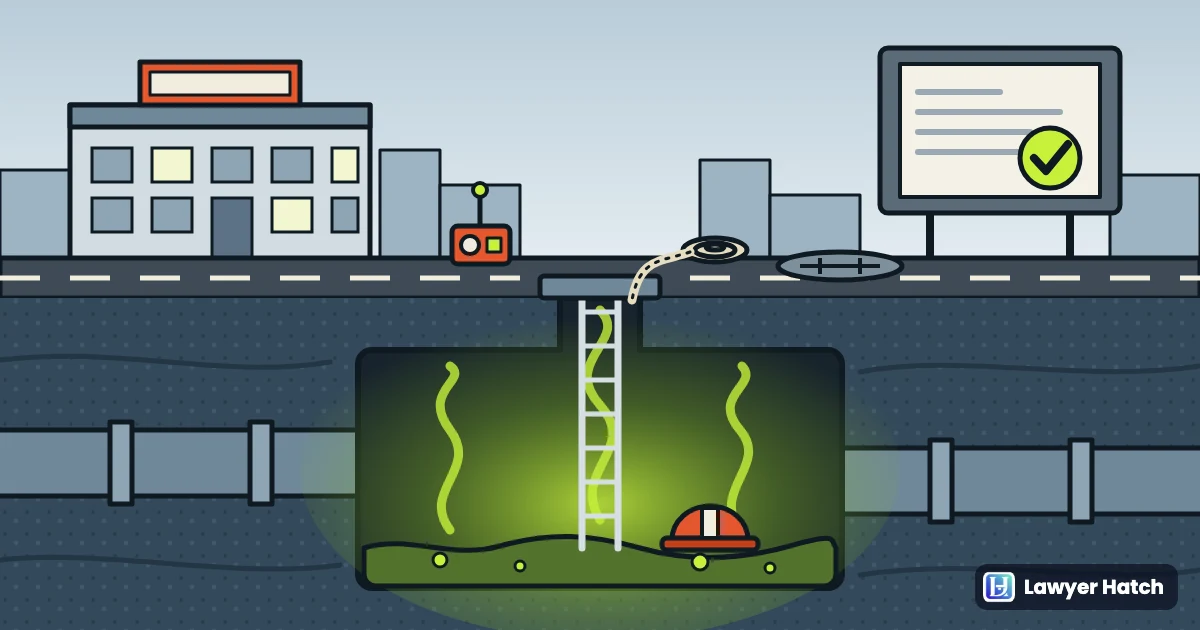
On the night of 31 October, four people went into a waste chamber at a hotel on the Ujjain-Dewas road in Madhya Pradesh and did not come out. Police suspect suffocation. Two others who went in to help fell ill and have since been discharged. Chief Minister Mohan Yadav announced ₹4 lakh for each family, and the district administration said it would look into, among other things, whether the four entered to clean the chamber or fell in by accident.
The Hindu's 6 November editorial, Danger in the sewer, uses those deaths as its example. But its real subject is the distance between two sentences. The first is what the government has maintained since at least 2021: the practice of manually cleaning excreta from insanitary latrines has been eliminated. The second sits in the Parliament and commission data the editorial cites: 859 people died on jobs involving sewers and septic tanks between 2014 and 2025.
Both sentences can be true at once, and that is exactly why this makes a good CLAT passage. A lawyer's first question about Ujjain would be a question about words: does a hotel's food-waste chamber count as a "sewer" or a "septic tank" as the 2013 law defines them? The editorial does not settle that, and neither do the reports I read. Keep the question in mind. It is the whole article in miniature.
- The editorial's charge: the state has let "manual scavenging eliminated" sound like "the root problem is solved", while deaths in sewers and septic tanks (859 in 2014-25, 1,350 in 1993-2025) have never headed to zero.
- Why both can be true: since 2013 the law treats manual scavenging (handling excreta from insanitary latrines and similar places) and hazardous cleaning of sewers and septic tanks as two different things. A claim about the first says nothing about the second.
- The Supreme Court narrowed the gap: in Dr Balram Singh (2023) it said hazardous cleaning without proper gear is forced labour (Art 23), a mark of untouchability (Art 17), and an insult to dignity (Art 21). It set ₹30 lakh as compensation for a sewer death.
- The editorial's conclusion is about method: remove the situations that lead to deaths, instead of handing out kits and calling it progress.
- The best reply: the official yearly toll has fallen from 88 in 2022 to 47 in 2025, and 89,915 workers have been validated under the NAMASTE scheme.
Three words doing the heavy lifting
Read an official statement the way you read a contract: look first at the defined terms. Three words carry this story.
| Word | What it covers | What falls outside it | What it does to the count |
|---|---|---|---|
| "Eliminated" (the government's claim) | Manual cleaning of excreta from insanitary latrines, as the editorial describes it | Sewers, septic tanks and every other chamber where someone has to climb down | A 2024-25 survey had all districts declare themselves "manual-scavenger-free", the Centre told the Lok Sabha |
| "Manual scavenger" (legal term) | A person employed to clean or handle human excreta in an insanitary latrine, an open drain or pit it empties into, or a railway track. Someone doing the work with notified devices and gear is "not deemed" one | Entering a sewer or septic tank | Earlier surveys (2013, 2018) identified 58,098 people. The 2024-25 exercise identified none |
| "Hazardous cleaning" (legal term) | Manual cleaning of a sewer or septic tank without the employer providing protective gear, devices and safety precautions | Cleaning done with the required gear (regulated, not banned), and chambers that are not a "sewer" or "septic tank" by definition, an open question for a hotel waste chamber | Deaths are filed here. The same Lok Sabha reply reported 498 of them since 2019 and no manual-scavenging deaths |
None of those entries is false. That is the point: a definition can make a problem disappear on paper without anyone saying an untrue sentence. The editorial's complaint is not that the government lied. It is that the claim is heard as bigger than it is, and that the hearing has a cost: by signalling the root problem is dealt with, it frees administrative bodies from the urgency of inspecting municipalities and private establishments.
Two workers, one drain
To see how the law sorts people, take two invented workers. Arun empties the pit beneath an insanitary latrine with a bucket and his hands. Bilal is lowered into a municipal sewer by a contractor, wearing a mask and gloves but with no gas test, harness or rescue team, which falls short of what the Rules require.
| Question | Arun (manual scavenger) | Bilal (hazardous cleaner) |
|---|---|---|
| Is his employment prohibited? | Yes. Employing a manual scavenger is banned outright | Entering a sewer without the required gear and safeguards is penalised. With them, entry is regulated, and the Rules allow it only in listed exceptional situations |
| Does the Act give him rehabilitation? | Yes, once identified in a survey list: cash assistance, scholarships for children, a plot or house, skill training, a loan | No. The Act has no rehabilitation scheme for hazardous cleaners |
| If he dies, who counts him? | The government's reply: no manual-scavenging deaths reported | A sewer-death statistic, with a ₹30 lakh floor on compensation, set by the Court rather than the statute |
A senior advocate in Balram Singh argued that this split between the two kinds of work has no rational basis and breaches the equality guarantee (Art 14). The Court said it could not strike down the difference because the Act itself was not under challenge. But it also said the Constitution's promises behind the Act must benefit sewer workers, and it extended entitlements "akin to" those of manual scavengers to the families of those who die in sewers and septic tanks.
The same numbers, read properly
Here is the official yearly toll of deaths while cleaning sewers and septic tanks, from National Commission for Safai Karamcharis (NCSK) data given to the Lok Sabha in early August 2026.
| Year | 2019 | 2020 | 2021 | 2022 | 2023 | 2024 | 2025 | Jan-Jun 2026 |
|---|---|---|---|---|---|---|---|---|
| Deaths | 132 | 34 | 62 | 88 | 65 | 54 | 47 | 16 |
Add all eight and you get 498, the figure the editorial gives for 2019 to mid-2026. Add the last six, 62 + 88 + 65 + 54 + 47 + 16, and you get 332, the editorial's figure for 2021-26 across 18 States and Union Territories. These are one series with two start dates. Nobody is contradicting anybody.
The editorial's longer figures, 859 for 2014-25 and 1,350 for 1993-2025, are different windows and should not be subtracted from the shorter ones to get a neat answer. The 332 deaths were spread unevenly: Maharashtra 58, Haryana 47 and Tamil Nadu 38 led the list, according to ThePrint's report of a July 2026 Lok Sabha reply. The same reply said 193 FIRs were lodged over five years. That is not a like-for-like window, but the gap between 193 and 332 is wide.
Now the fair counter. The yearly toll has fallen: 132 in 2019 and 88 in 2022, down to 47 in 2025. The editorial says the numbers have "never tended towards zero", which is true, but it does not engage with the downward slope. It does add that the Safai Karamchari Andolan has repeatedly alleged severe under-reporting, which means the height of the whole line is itself contested.
What the Court did when the form and the pit disagreed
| When | What happened | What it added |
|---|---|---|
| 27 Mar 2014 | Safai Karamchari Andolan v Union of India | The Court said the 2013 Act does not dilute Art 17 and noted States had acted in denial of the earlier 1993 law. It ordered rehabilitation of identified manual scavengers and ₹10 lakh for families of those who died in sewers and septic tanks since 1993 |
| 20 Oct 2023 | Dr Balram Singh v Union of India (Justices Bhat and Aravind Kumar) | Extended the logic of Arts 17, 21 and 23 to hazardous cleaning, raised compensation, and put contractors on the hook (details below) |
| Jan 2025 | Order covering six big cities | The Court banned manual scavenging and manual sewer cleaning in six metropolitan cities, Bengaluru and Hyderabad among them |
| 27 Jul 2026 | Contempt notices | The bench said its directions seemed not to have reached the ground and asked Chief Secretaries to show cause within four weeks. The editorial counts 15 States; one legal-news report counts five |
Balram Singh is the case to understand. The editorial adds a fact that explains why Article 17 matters here: members of historically marginalised castes are overrepresented in these jobs. The Court used three Articles, each in a different way.
| Article | In plain words | How the Court used it |
|---|---|---|
| Art 17 | Untouchability is abolished and enforcing any disability from it is an offence | Hazardous cleaning, like manual scavenging, is a manifestation of untouchability, so protections must reach sewer workers even where the Act gives no rehabilitation |
| Art 21 | Life and personal liberty, read to include dignity | Dignity must be ensured through rehabilitation: families of the dead get scholarships and support, not only cash |
| Art 23 | Begar and similar forced labour is prohibited | Forced labour is not only unpaid work. Where minimum protective gear is not provided, the employment is forced labour, and the defence that the worker went in "voluntarily" fails, because a contract can look voluntary when poverty leaves no real choice |
The operative directions are the practical part:
- No entry on outsourced jobs: sewer work handed to contractors or agencies must not require individuals to enter sewers "for any purpose whatsoever", to be phased in.
- Compensation: ₹30 lakh for a sewer death, at least ₹10 lakh for disability, and at least ₹20 lakh where permanent disability leaves the victim economically helpless.
- Accountability: where deaths occur on contracted work, the contract is to be cancelled at once with monetary liability, and a model contract is to be drawn up under which the agency loses the contract and may be blacklisted.
- Paper trail: a national survey, scholarships for dependents, and a portal tracking sewer deaths and compensation.
Cross-examining the editorial
The editorial opens by saying India loses sanitation workers to "foreseeable, and largely preventable" circumstances. Three tests show how well its argument stands up.
Is the "paper problem" charge fair?
- The editorial: the "eliminated" claim signals the root has been addressed, and so loosens inspection of municipalities and private establishments.
- The government's best reply: its Parliament replies keep the two categories separate and openly publish the 498 hazardous-cleaning deaths. No number is hidden.
- Verdict: the figures are on the table, so the dispute is about what the word signals. The link from signal to slack inspection is the editorial's assertion; the piece offers no inspection data to prove it.
Does the contractor argument follow?
- The editorial: private contractors and municipal bodies evade liability by hiring undocumented daily-wage workers, so deaths cannot end without formalising employment and extending social security across caste lines.
- A fair reply: the Court has already made contractors answerable, through contract cancellation and blacklisting.
- Verdict: a worker with no record has no employer on paper, so liability is hard to attach, which is why the editorial pairs formal employment with prevention. The July 2026 contempt notices suggest the Court itself thinks enforcement is the weak point. What the editorial does not show is how many deaths involve undocumented workers.
Does the remedy fit the diagnosis?
- The editorial: under the National Action for Mechanised Sanitation Ecosystem (NAMASTE) scheme, aims and outcomes have drifted apart, because the state measures its help (kits) instead of the number of situations that could kill a worker.
- The government's best reply: 89,915 sewer and septic-tank workers validated, 87,037 protective kits, 753 safety devices for emergency response units, and ₹97.68 crore released and spent in 2025-26. A used-water component under Swachh Bharat Mission-Urban 2.0 aims at mechanisation.
- Verdict: asked whether the government had evaluated mechanised sewer cleaning across States, the minister answered "No". That fits the editorial's point that outputs are counted, outcomes less so. The editorial's remedy also matches the Court's own test, which was "no one enters", not "everyone enters with a kit".
Still unknown: whether the 2024-25 survey's zero can be trusted, how many deaths in hotels and other commercial chambers fall inside the Act's definitions at all, what the true toll is if under-reporting is real, and whether the Ujjain chamber counts.
Four moves to take into any argument passage
| Move | What it looks like here | Question to ask |
|---|---|---|
| Equivocation | "Manual scavenging" shifts from a narrow legal term to a wide everyday meaning | Is the word used the same way in the premise and the conclusion? |
| Scope of a definition | "Eliminated" covers latrine excreta, not sewers | What does the definition leave out? |
| Output versus outcome | Kits distributed versus deaths prevented | Is the measure the thing we care about, or a stand-in for it? |
| Zero found is not zero exists | A survey that identifies no manual scavengers | How good was the search? |
Try it on a road-safety committee that reports no black spots
The passage below is an invented example built on the same move. Read it, then answer the six questions.
Which statement best captures the author's main point?
▸ Show solution
With which statement would the author most likely agree?
▸ Show solution
The author's claim that scattered junctions "sit outside every programme" depends on which assumption?
▸ Show solution
Which finding, if true, would most weaken the author's claim that scattered junctions fall outside every programme?
▸ Show solution
<b>Rule (simplified from Balram Singh):</b> where a worker enters a sewer or septic tank without the required protective gear and devices, the employment is forced labour, and the worker's apparent willingness does not excuse the employer.<br><br>A housing society in Lucknow hires a contractor, who sends Rajesh Yadav, a daily-wage worker, into the society's septic tank with no gas test, harness or breathing equipment. Rajesh asked for the job because he needed the ₹800. The contractor says: "He volunteered, so nobody can blame me." Applying the rule, the best response is:
▸ Show solution
A columnist writes: "The official toll fell from 88 in 2022 to 47 in 2025, so the sewer-death problem is nearly solved." Which is the most serious weakness in this reasoning?
▸ Show solution
Connect the dots
Sources
- The Hindu: Danger in the sewer: On India's sewer cleaning deaths (editorial, 6 Nov 2026)
- ThePrint: Four die of suspected suffocation while cleaning waste chamber in Ujjain hotel
- ThePrint: 332 sanitation worker deaths since 2021, govt tells Lok Sabha (July 2026 reply)
- Business Standard: Nearly 500 sewer, septic tank cleaning deaths since 2019, Centre tells LS (5 Aug 2026)
- LiveLaw: Supreme Court issues contempt notices over manual scavenging deaths (27 Jul 2026)
- Bar & Bench: Contempt notices to 15 States on manual scavenging (27 Jul 2026)
- Supreme Court of India: Dr Balram Singh v Union of India, W.P.(C) 324/2020, judgment of 20 Oct 2023 (2023 INSC 950), full text
- Supreme Court of India: Safai Karamchari Andolan v Union of India, W.P.(C) 583/2003, judgment of 27 Mar 2014, full text
- The Constitution of India, Articles 17, 21 and 23
Frequently asked questions
What does The Hindu's "Danger in the sewer" editorial argue?
What is the difference between manual scavenging and hazardous cleaning?
How much compensation does the Supreme Court award for a sewer death?
How many people have died cleaning sewers and septic tanks in India?
Which Articles of the Constitution apply to manual scavenging and sewer deaths?
What is the NAMASTE scheme?
Keep reading