📑 On this page
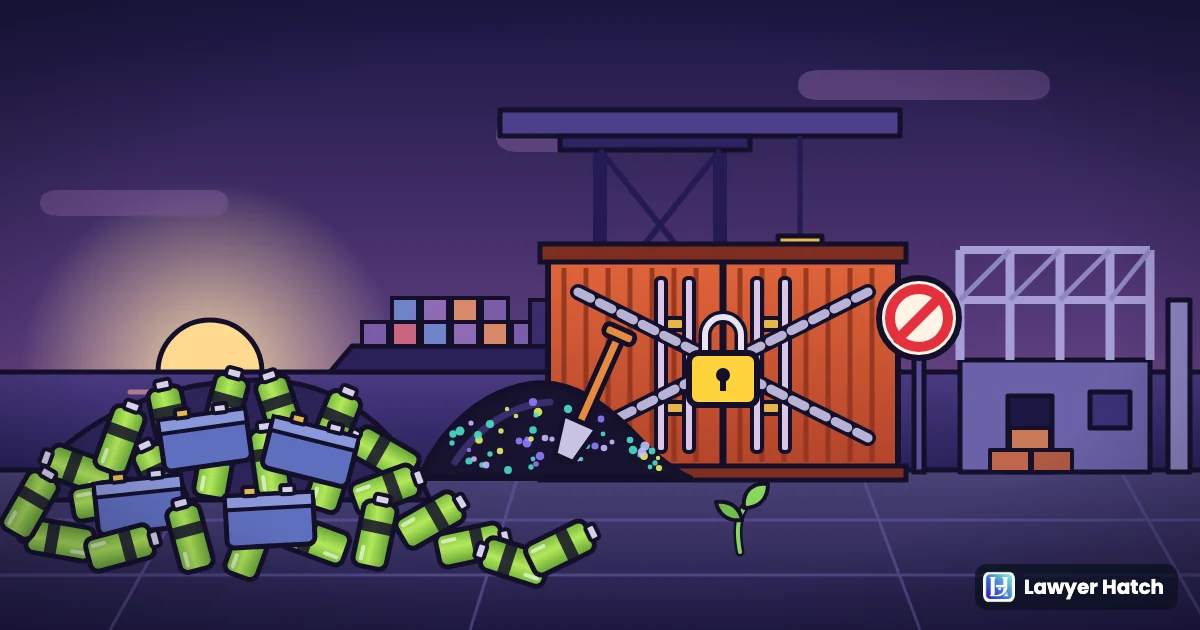
On 10 November 2026 the Directorate General of Foreign Trade (DGFT) moved one item on India's export list from "Free" to "Prohibited": lithium-ion battery black mass. The order took effect immediately and stays until further orders. Black mass is the dark powder you get when dead batteries and factory scrap are shredded, and it is full of metals India mostly imports.
On 14 November The Hindu's editorial "Critical ban" accepted the aim and doubted the method: shutting an export door does not build the room on the other side. Below, both sides speak, each answers the other, and then we sort what is settled from what is only claimed.
- Notification No. 49/2026-27, dated 10 November 2026, moves black mass (ITC(HS) code 85491400) from "Free" to "Prohibited", with immediate effect and until further orders (PIB).
- The government's case: recycling and refining capacity is under-used for want of feedstock, and some recyclers even import black mass. Keep it home and the plants fill up.
- The editorial's case: a ban redirects supply but builds no market. Turning black mass into battery-grade chemicals needs costly, specialised processing; without it, spent batteries may reach landfills.
- Its fixes: a floor price for EPR certificates and a separate EPR category for rare earths.
- Not known: how much black mass India exported. None of the sources we read gives that figure.
From dead battery to new battery: where black mass sits
The whole debate depends on one chain. The ban acts at step three; the editorial's worry lives at step four.
- 1
CollectSpent EV and phone batteries, plus rejects from cell factories, are gathered.
- 2
ShredThe cells are crushed, a largely mechanical job.
- 3
Black massThe powder that results holds lithium, cobalt, nickel, manganese and graphite. This is the item now banned from export.
- 4
Chemical processingRecyclers separate the metals, typically by hydrometallurgy (using liquid solutions, not furnace heat), into compounds a battery maker can use. This step is specialised and needs larger investment.
- 5
New cellsIf the refined output exists, it can feed Indian battery manufacturing directly.
Voice one: our waste, our metals, so keep it here
Start with the Commerce Ministry's release. It says India's capacity to recycle battery waste and refine minerals has grown considerably but is not fully used, because feedstock is short. Black mass made in India was being exported, while some domestic recyclers had to import material to keep running.
Seen that way, the old position looks odd: a country that imports much of its battery minerals let its own source leave as a powder. The release expects the ban to assure feedstock, lift capacity use and attract investment and jobs. It also calls this "urban mining": treating discarded products as an ore body, easing pressure on primary mining.
The strongest version of this voice is about certainty. A refiner deciding on a plant wants to know the powder will not be shipped abroad the day a foreign buyer bids higher. A prohibition gives that assurance more firmly than a promise. The release adds that several major economies also keep such waste for domestic processing, without naming them.
Voice two: a ban makes a rule, not a buyer
The editorial does not say black mass should leave. It says the ban only redirects supply. Lead-acid battery recycling is established and formalised; lithium-ion recycling is an emerging segment with "a few dozen licensed operators", though EV use is large.
Spell the reasoning out. Shredders and collectors earn by selling black mass. If the only legal buyers are a few refiners who cannot yet absorb it all, or will not pay much, collecting stops paying, and collectors stop collecting. That is how the editorial reaches its warning: with no market for black mass, spent batteries may be dumped in landfills.
Its deeper point concerns the missing step. Making black mass is mostly mechanical; the chemistry after it needs bigger investment and further policy support. If those units come online, their output can feed battery manufacture. Until then, the ban fills a pipe that drains into a closed tap.
Voice one replies: the missing step already has money behind it
The government's answer is that the money came first. On 3 September 2025 the Union Cabinet approved a ₹1,500 crore Incentive Scheme for Critical Mineral Recycling under the National Critical Mineral Mission (NCMM). Its design matters: it rewards the recyclers who actually extract critical minerals, not those who only make black mass. Support is a 20% capex subsidy plus an opex subsidy, capped at ₹50 crore per large entity and ₹25 crore per small one, with a third of the outlay earmarked for small, new recyclers.
By 30 April 2026 the Ministry of Mines had cleared 58 companies as eligible, with pledged capacity of about 850 KTPA (kilo tonnes per year) and pledged investment of about ₹5,000 crore. Underline pledged: the release says the next stage is project execution. A separate ₹2,814 crore scheme approved on 4 November backs lithium and nickel processing plants, but the lithium plants are for ores and concentrates, so it does not directly answer the black mass question.
On landfills, the Battery Waste Management Rules, 2022 already require waste batteries to be collected and sent for recycling or refurbishment, and prohibit landfilling and incineration. Dumping would be illegal; what remains is enforcement.
Voice two replies: price, not paperwork, decides what gets built
The editorial's second step is the price of the paper. Under the 2022 rules, producers meet their EPR (extended producer responsibility) targets by buying EPR certificates from registered recyclers. The editorial says these certificates are undervalued, so recycling on paper pays better than investing in high-yield plants. It wants a floor price covering the full cost of recovery, with digital tracking.
Official numbers show a gap, though not of price. In an August 2025 Rajya Sabha reply the government said producers had bought certificates for 7.29 lakh tonnes of key battery metals against a target of 10.96 lakh tonnes, roughly a third short. That shows quantity lagging; it does not show prices too low.
The rare earths argument is the editorial's alone; we have not checked its figures. It says a smartphone can be up to 1% neodymium-iron-boron magnet by weight, about 3,000 parts per million (0.3%) of rare earth, comparable to India's monazite beach sands, and that hard-drive magnets are usable only if removed before shredding. The e-waste rules, it says, do not require rare earth separation. Because payment by weight cannot capture a few grams that matter, it asks for a separate EPR category.
Settled, contested, unknown
| Claim | Where it stands | Why |
|---|---|---|
| The ban exists: Notification 49/2026-27, 10 Nov 2026, code 85491400, Free to Prohibited, immediate | Settled | PIB and ANI report the same wording. |
| Black mass holds critical minerals that India largely imports | Settled | PIB and The Hindu agree. |
| Domestic recyclers are short of feedstock | Government's claim | No tonnage or export figure in the sources we read. |
| Processing capacity is the real bottleneck | Contested | PIB (Oct 2025) said capacity to process black mass was limited; the Nov 2026 release says capacity has grown but is under-used. |
| The ban will push batteries into landfills | A prediction | Landfilling is already barred; the outcome turns on enforcement and on refiners buying. |
| EPR certificates are undervalued | Unproven | The data we read give tonnes, not prices. |
| Rare earths need their own EPR category | The editorial's proposal | Its figures are its own and unchecked. |
The lever and the rulebook: GK you can use
| Term | Plain meaning | Where it shows up here |
|---|---|---|
| DGFT | The Commerce Department's office that issues foreign-trade notifications | It issued Notification 49/2026-27. |
| Foreign Trade (Development and Regulation) Act, 1992 | The parent law for regulating imports and exports | The notification cites Section 3 read with Section 5 (ANI). |
| Foreign Trade Policy 2023 | The policy document the Act supports | Para 1.05 transitional arrangements apply (PIB). |
| ITC(HS) code; "Free" vs "Prohibited" | The product code used in trade policy; export status, from open to barred | Black mass, code 85491400, moved from Free to Prohibited. |
| Battery Waste Management Rules, 2022 | Published by MoEFCC in August 2022; cover EV, portable, automotive and industrial batteries; replaced the 2001 rules | The base of EPR for batteries. |
| EPR (extended producer responsibility) | Producers, including importers, must see that what they sell is collected and recycled | Certificates are traded between producers and recyclers on an online portal. |
| National Critical Mineral Mission | Approved 29 Jan 2025 with ₹16,300 crore of government expenditure, plus expected ₹18,000 crore from PSUs | Parent of the ₹1,500 crore recycling scheme (Ministry of Mines). |
Read it like an examiner: six questions
The passage below is invented for practice: the place, the order and the people are made up, but the shape of the argument mirrors the editorial.
Which of the following can be inferred from the passage?
▸ Show solution
The author's warning that shells will be burnt in the open assumes that:
▸ Show solution
Which new fact would most weaken the author's warning?
▸ Show solution
Which finding would most strengthen the author's proposal of a published minimum price instead of a ban?
▸ Show solution
A notification like the black mass ban, changing an item from "Free" to "Prohibited", is issued by which body, under which ministry?
▸ Show solution
Under the Battery Waste Management Rules, 2022, on whom does the duty to see that waste batteries are collected and recycled mainly fall?
▸ Show solution
Keep going
Sources
- The Hindu editorial: Critical ban, on recycling of lithium-ion batteries (14 Nov 2026)
- PIB: DGFT prohibits export of Lithium-Ion Battery Black Mass (11 Nov 2026)
- ANI via Devdiscourse: Govt bans export of specified lithium-ion battery waste and scrap (11 Nov 2026)
- PIB: Cabinet approves Rs.1,500 crore Incentive Scheme for Critical Mineral Recycling (3 Sep 2025)
- PIB: A strong push for critical mineral extraction from recycling (24 Oct 2025)
- PIB: 58 Companies Eligible for Recycling Scheme (30 Apr 2026)
- PIB: Cabinet approves Capex Support Scheme for Critical Mineral Processing (4 Nov 2026)
- PIB: Cabinet approves National Critical Mineral Mission (29 Jan 2025)
- PIB: Government notifies Battery Waste Management Rules, 2022 (25 Aug 2022)
- PIB: Parliamentary Question, Circular Economy for Batteries (21 Aug 2025)
Frequently asked questions
What is black mass and why did India ban its export?
What is the DGFT notification number and effective date for the black mass ban?
What does The Hindu editorial say about the black mass export ban?
What is EPR under the Battery Waste Management Rules, 2022?
What is the National Critical Mineral Mission?
Which Act empowers DGFT to ban exports?
Keep reading