📑 On this page
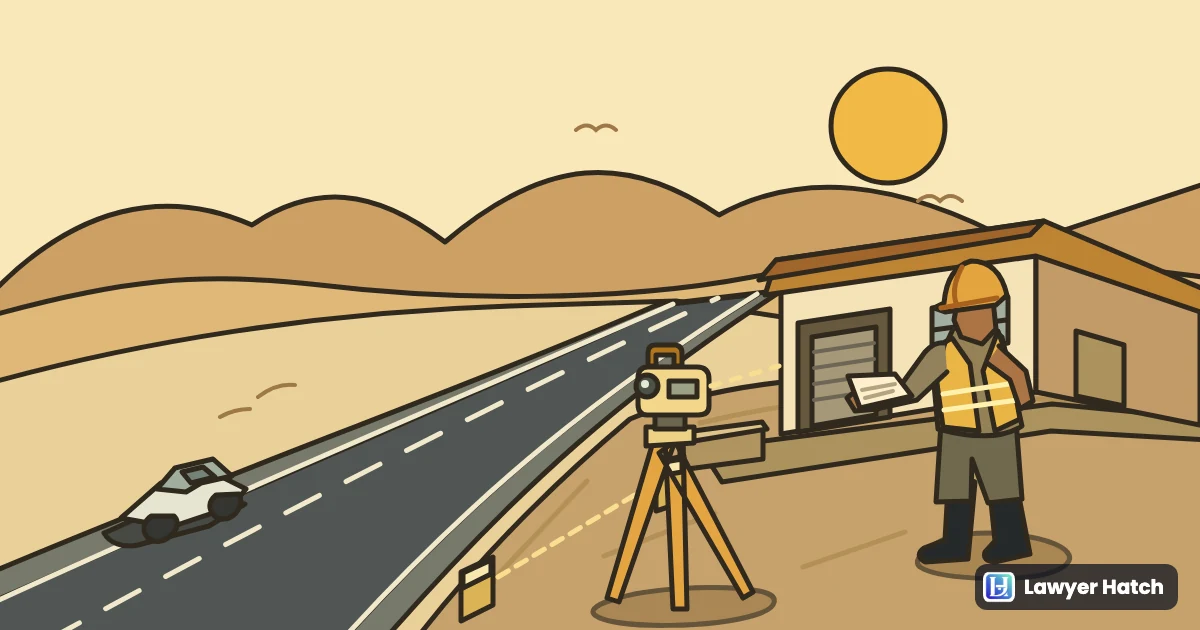
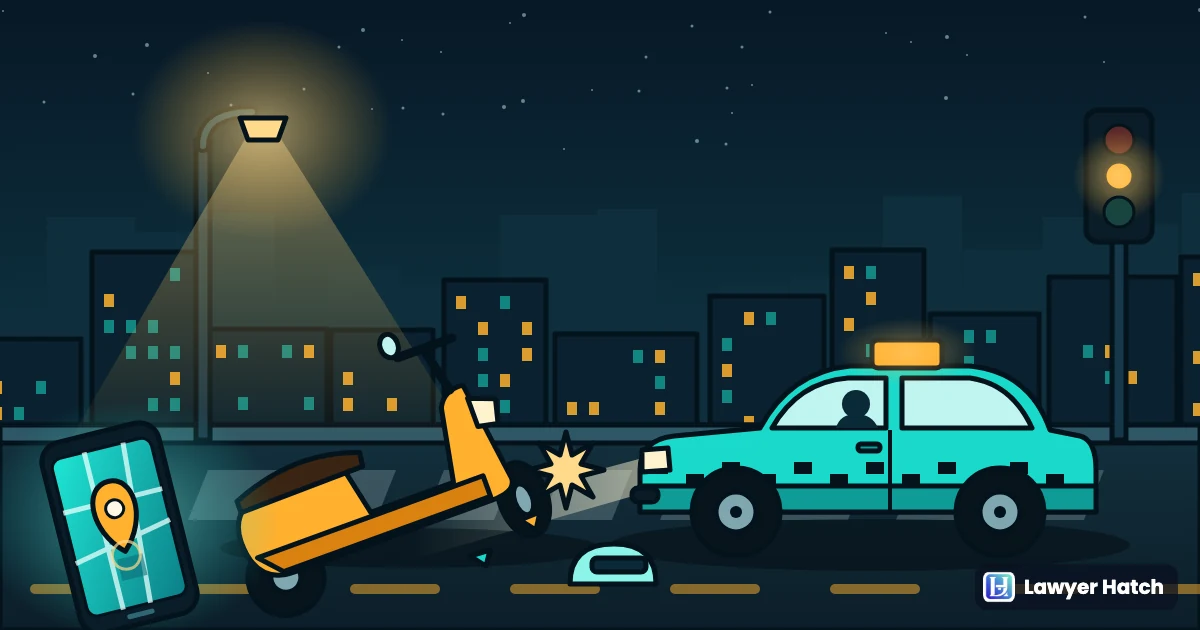
It is 10:40 pm at a junction in Pune. Neha Kulkarni, riding home on her scooter, is clipped by a cab that jumps the signal. A broken collarbone, a folded scooter, a night in hospital. The cab was booked on an app, driven by Imran, owned by his cousin Farid, and covered by a motor insurance policy. The police report names the driver. Neha's lawyer will want to name more.
Four parties could be asked to pay. Three sit on fairly settled law. The fourth, the app, is where Indian courts are still working things out, and that makes this a good CLAT topic: you are asked to hold a clear rule steady while a new business model leans on it. Yesterday's piece was about what the new gig-worker boards mean for a driver like Imran. This one is about the person he hit.
- The driver is personally liable for his own negligence. That part is never in doubt.
- The owner is liable for the driver's wrong if the driver was his servant acting in the course of the job, or was driving with his consent on his business or purposes.
- The insurer of a vehicle with the compulsory policy owes the duty to the victim. It usually pays first and, if the owner broke the policy, collects from the owner later.
- The app says it is only a marketplace. Whether it can be made to pay as the "principal" is open, and the Supreme Court has not settled it.
- The test that runs through all of it: who really controlled how the work was done, whatever the contract calls the relationship.
Four names on one petition
To get compensation for a road accident, Neha files a claim before the Motor Accident Claims Tribunal, a special court that handles only such claims. She can name several respondents at once. Here is the line-up and the legal hook for each.
| Respondent | Why they could be made to pay | How settled is it? |
|---|---|---|
| Imran (driver) | He committed the negligent act himself | Settled |
| Farid (owner) | A master answers for a servant's wrong; an owner answers when the driver acts on the owner's business | Settled, though it turns on facts |
| The insurer | The compulsory third-party policy exists to protect victims like Neha | Settled, with narrow defences |
| The app company | Its control over the driver, and the duties its licence carries | Open |
Door 1: Imran, who actually did it
Everyone is liable for their own negligence. If Imran jumped a red light, he owes Neha damages the way he would if he had been in a private car. Nothing about the app changes that.
The trouble is practical. A driver's savings rarely match a surgery bill and a year of lost income. So the law has built other doors, and the rest of this piece is about those.
Door 2: Farid, the owner, and the question of control
Vicarious liability means being made to answer for someone else's wrong because of the relationship between you. It is not about blame in the owner's own conduct. The classic case is the employer and employee: the employer takes the profit of the work, so the employer carries the risk.
It has a boundary, and the boundary is where cases are fought. A master answers for a servant acting in the course of employment. He generally does not answer for an independent contractor, someone who runs their own work and is not told how to do it. Textbooks separate the two by control: a servant works under the direction of the master, including how the job is done.
Three Supreme Court cases show how this plays out with vehicles. They are in the note at the end if you want the names; the ideas matter more.
- A stranger at the wheel. A taxi owner gave his car to a manager, who trained the cleaner to drive and took him for a licence test. The cleaner crashed during the test and crushed a pleader's leg. The Court, by a majority, held the owner was not liable: nothing showed he had authorised that. The law presumes a car is being driven on its owner's business, but the presumption can be rebutted, and here it was.
- A lift on a company trip. A company manager, driving the company car, gave a lift to a man who died in the crash. The Court held the company liable and accepted a wider rule: an owner is liable not only for a servant acting in the course of employment, but also where the driver, with the owner's consent, drives on the owner's business or for the owner's purposes.
- A borrowed driver. A state transport corporation hired a bus with its driver from a private owner and ran it on its own permit route, with its own conductor taking fares. When the bus was swept away in a flooded river, killing 23 passengers, the corporation could not hide behind the owner. The driver stayed on the owner's payroll, but day-to-day control had moved to the hirer, and control decided it.
Put Farid in this picture. If Imran is Farid's salaried driver, on duty, running a booked trip, Farid answers for him. If Imran has taken the car without permission to a cousin's wedding, he is on his own errand and Farid's liability weakens. If Imran owns the cab himself, the owner and driver are one person and the question collapses into Door 1.
Door 3: the insurer, whose duty runs to Neha, not to Farid
Every vehicle on the road must carry third-party insurance. The Supreme Court has described this part of the Motor Vehicles Act as a social welfare law whose object is to give accident victims compensation, and said the provisions must be read to serve that object. The insurer's promise is really a promise to the stranger who might get hurt.
That is why the insurer's usual defences are narrow. Take the commonest: the driver's licence was fake, expired or for the wrong class of vehicle. The Court has held that the mere absence or invalidity of a licence is not enough for the insurer to walk away. It must prove that the owner was at fault, for instance by failing to take reasonable care to check the licence, and even then the breach must be so fundamental that it contributed to the accident. A driver holding only a learner's licence does not free the insurer either.
When the insurer does prove a breach, the arrangement is pay and recover. The insurer pays the victim first, and then the Tribunal can order the owner to reimburse it. Neha gets paid either way. The fight about who is really at fault happens between the insurer and Farid afterwards.
| Situation | Does Neha get paid by the insurer? | Who may end up bearing the cost? |
|---|---|---|
| Licence valid, policy in force | Yes | The insurer |
| Licence turns out fake, but Farid checked it with care | Yes | The insurer, since no fault by the owner is shown |
| Farid knew the licence was fake and handed over the keys anyway | Yes, first | Farid, through pay and recover |
| Driver held a learner's licence only | Yes | The insurer |
Door 4: the app, where the argument starts
Here is what the statute says. The Motor Vehicles Act now defines an aggregator as a digital intermediary or marketplace for a passenger to connect with a driver for the purpose of transportation. It came in with the 2019 amendment, which also requires aggregators to hold a licence, and the Centre has issued Motor Vehicle Aggregator Guidelines (2020, revised in 2025, as LegalRepublic reports) that cover things like driver checks, insurance and complaint handling.
One thing to keep straight: this is not the definition from yesterday's piece. The Code on Social Security, 2020 defines an aggregator as a digital intermediary connecting the buyer of a service with its provider. Two laws, two definitions, written for two purposes.
The definition says "intermediary". The duties say "somebody with responsibility". That tension is the whole dispute, and it is best read as two fair voices.
| The app is only a marketplace | The app is the principal |
|---|---|
| The terms call the driver an independent business using the app for a commission. In classic law, a principal is not liable for an independent contractor. | The app assigns the trip, fixes or shapes the fare, rates drivers and can suspend them. That looks like control, the very thing the borrowed-driver case turned on. |
| The IT Act gives an "intermediary" a conditional safe harbour from liability for what third parties do through its platform. | The safe harbour is conditional on due diligence. And it was written with online content in mind, so stretching it to a collision on a highway is a big step. |
| The aggregator licence and the Guidelines are public-law rules enforced by the licensing authority, not rights for an injured person to sue on. | Courts often let regulatory duties shape the duty of care. A duty to vet drivers, if broken, may be a cause of the harm. |
| Liability should follow the person who can actually prevent the accident: the driver and the owner of the car. | Liability should follow the person who profits from the trip and designs the system: the app. |
Notice what each side really argues about. Not whether Imran was careless, but how to describe the app's relationship to him. The marketplace side says contract, the principal side says reality. As LegalRepublic reports, a claim that merely says "the app is liable" is likely to fail. The claimant would have to show specific facts: that the trip was booked on the platform, and that the app failed in a particular duty that connects to the accident. That also means a driver who has logged off and is driving home for his own reasons is outside any such theory.
A label is not a verdict
Courts rarely accept that a contract's name for a relationship settles its legal nature. They look at how the arrangement works. Three questions come up again and again, and CLAT passages tend to build on them.
| Test | The question it asks | Which way it points for a cab app |
|---|---|---|
| Control | Who decides how, when and where the work is done? | Mixed. Drivers pick their hours but the app dictates the route, fare and rating rules. |
| Whose business is it? | Is the work part of the company's own business or a separate business of the worker? | The app's product is the ride, which points toward the app. |
| Who carries the risk? | Who owns the tools, bears the costs, and keeps the profit? | Mixed. The driver pays for the car and fuel, the app collects the fare and takes a cut. |
Abroad, the UK Supreme Court decided Uber BV v Aslam on 19 February 2021. The issue was whether Uber drivers were "workers" entitled to rights such as the minimum wage, and the Court held they were. Two cautions for a CLAT reader. First, it was an employment case, not an accident case, so it does not tell you who pays Neha. Second, it is foreign law. Its value is the method: the Court looked at how the service actually ran rather than at what the contracts said.
What is settled, what is not
| Settled | Still open |
|---|---|
| A driver is personally liable for his own negligence. | Whether an app can be vicariously liable for an on-trip accident. |
| An owner is liable where the driver is a servant in the course of employment, or drives on the owner's business with consent. | How far the app's licence duties become duties owed to a victim. |
| An insurer must satisfy a third-party award, subject to narrow defences and pay and recover. | Whether the insurer's right to recover can run against the app. |
| Control can move from owner to hirer along with the driver. | Whether the IT Act safe harbour can shield a transport platform at all. |
- "The owner always pays." No. Where the driver is on a private errand without consent, the owner may escape.
- "No licence means the insurer pays nothing." No. The insurer must prove fault and a fundamental breach by the owner, and can still owe the victim first.
- "Payroll decides." No. Control decides.
- "The contract calls him a partner, so the app is safe." A label is only one fact, not the answer.
- Mixing up the victim's remedies. Neha's claim against the insurer is for compensation for the accident. A rule about aggregators in a labour law is not a rule about road accidents.
Five scenes from the road
Dinesh, a salaried driver of Mrs Sharma's fleet in Jaipur, is told to take a car to a customer's home. On the way he hits a cyclist, Ramesh, through careless driving. Who is liable to Ramesh under the rules?
▸ Show solution
After duty, Dinesh drives the same car, without telling Mrs Sharma and against her standing instruction, to his cousin's wedding in another town and hits a scooter rider. Which statement best fits the rules?
▸ Show solution
Hasina's taxi is insured. When she hired driver Bilal she checked his licence, which looked valid. It later turned out to have expired a month earlier. Bilal injures a pedestrian, Kiran. The insurer refuses to pay anything because the licence was invalid. What do the rules say?
▸ Show solution
A claimant argues that a cab app should be treated as the employer of the drivers on its platform. Which fact would most WEAKEN that claim under Rule 2?
▸ Show solution
Suppose a new law made an app jointly liable with the driver for any accident that occurs during a trip booked through the app, but said nothing about other times. Meena finishes her booked ride in Chennai. Twenty minutes later, with his app switched off, the driver heads home, goes through a signal and injures a pedestrian, Gopal. What follows?
▸ Show solution
Keep going
Sources
- Legal Republic: Who pays when an Ola or Uber driver causes an accident
- UK Supreme Court: Uber BV v Aslam [2021] UKSC 5, case page
- Supreme Court of India judgments: Sitaram Motilal Kalal (1966), Pushpabai Purshottam Udeshi (1977), State Bank of India v Shyama Devi (1978), Rajasthan SRTC v Kailash Nath Kothari (1997), National Insurance Co v Swaran Singh (2004), read in full from the Court's reported texts
Frequently asked questions
Who pays if an Ola or Uber driver causes an accident in India?
Is Ola or Uber legally an employer of its drivers?
What is an aggregator under the Motor Vehicles Act?
Does the insurance company pay if the driver had a fake licence?
What is vicarious liability in simple words?
Can the IT Act safe harbour protect a cab app from accident claims?
Keep reading